
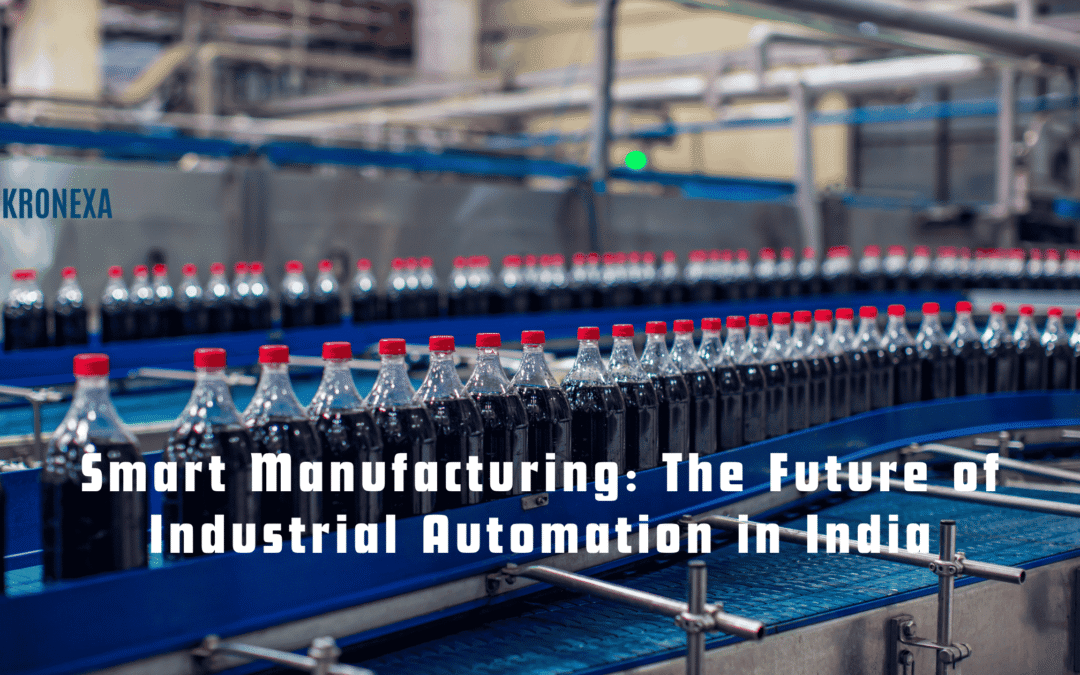
India’s manufacturing sector is on the brink of a revolutionary transformation. As the country accelerates its “Make in India” initiative and gears up to become a global manufacturing hub, smart manufacturing powered by industrial automation is paving the way. Automation is no longer a futuristic concept—it is the present need of the hour for industries striving for precision, speed, and global competitiveness.
In this blog, we explore how smart manufacturing and industrial automation are reshaping the Indian industrial landscape, the benefits businesses can unlock, and how companies like Kronexa Technologies are leading the charge toward an automated, efficient future.
What Is Smart Manufacturing?
Smart manufacturing integrates advanced technologies such as:
-
Robotics
-
IoT (Internet of Things)
-
AI and Machine Learning
-
Cloud Computing
-
Data Analytics
These systems work in sync to automate processes, optimize production, reduce waste, and make real-time decisions. It’s the core component of Industry 4.0, the fourth industrial revolution.
Unlike traditional automation, smart manufacturing is:
-
Connected – Systems communicate with each other.
-
Predictive – Data analytics anticipate issues.
-
Adaptive – Machines optimize workflows based on input data.
The Rise of Automation in Indian Industries
India’s industrial sectors—ranging from automotive, pharmaceuticals, packaging, and FMCG to electronics and logistics—are rapidly adopting automation solutions. With increasing labor costs, quality expectations, and the need for faster turnaround times, automation is no longer a luxury—it’s a necessity.
Key Drivers Behind the Shift:
-
Government push through initiatives like PLI schemes and Digital India
-
Demand for consistent product quality
-
Need to improve worker safety and efficiency
-
Post-COVID digital acceleration
Benefits of Industrial Automation
1. Increased Productivity
Automated systems work 24/7 with minimal downtime, resulting in a massive boost in production volumes.
2. Consistency and Quality
Smart automation ensures product uniformity and significantly reduces human error in manufacturing processes.
3. Reduced Operational Costs
Though automation requires initial investment, it pays back with lower labor costs, less rework, and optimal resource utilization.
4. Enhanced Safety
Automated machinery minimizes human interaction with dangerous equipment or hazardous environments.
5. Data-Driven Decisions
Real-time monitoring and analytics offer deep insights for predictive maintenance, inventory control, and operational improvements.
Challenges in Automation (And How to Overcome Them)
While the potential is enormous, Indian manufacturers face some challenges:
-
High Initial Costs
→ Solution: Opt for scalable solutions. Kronexa, for example, provides modular automation systems that grow with your business. -
Workforce Resistance
→ Solution: Upskilling workers and involving them in automation implementation can ease this transition. -
Integration with Legacy Systems
→ Solution: Kronexa specializes in custom solutions that seamlessly integrate with existing infrastructure.
Why Kronexa Technologies Leads the Way
At Kronexa Technologies, we design and deliver tailor-made automation systems like:
-
Industrial Conveyor Systems
Designed for maximum load handling, flexibility, and efficiency across industries. -
Reverse Vending Machines (RVMs)
Encouraging sustainability while automating waste management. -
Automated Labelling and Packaging Solutions
Speeding up production lines with precision-driven labelling and box-handling units.
What sets Kronexa apart:
-
Years of industry experience
-
Certified automation engineers
-
Focus on innovation and affordability
-
End-to-end support – from planning to post-installation services
Industries We Serve
🔹 Automotive – Precision assembly lines and parts management
🔹 Pharmaceuticals – Cleanroom automation and safe material handling
🔹 FMCG & Packaging – Automated labeling, packing, and inspection systems
🔹 Electronics – PCB handling, robotic arms, and micro-assembly
🔹 E-Commerce & Logistics – Smart conveyor systems and warehousing automation
Whether it’s a startup looking for entry-level automation or a large plant aiming for full smart manufacturing, Kronexa customizes solutions to suit every scale.
Automation Trends to Watch in 2025 and Beyond
🔹 Collaborative Robots (Cobots): Working alongside humans to boost productivity without replacing jobs.
🔹 AI-Powered Predictive Maintenance: Reduces unplanned downtime.
🔹 Digital Twins: Virtual models of physical processes for simulation and testing.
🔹 Green Automation: Sustainable processes with reduced energy consumption.
Getting Started with Smart Automation
Automation isn’t just about machinery; it’s a strategic shift in how businesses operate. Start by:
-
Identifying repetitive manual tasks
-
Measuring time and cost inefficiencies
-
Consulting with experts like Kronexa
-
Planning scalable automation rollouts
Conclusion
Smart manufacturing and industrial automation are not future concepts—they are happening right now in India. As global competition intensifies, the industries that adapt will thrive. Those that hesitate risk being left behind.
Whether you’re a manufacturer, logistics provider, or packaging company, investing in automation today is an investment in sustainability, efficiency, and growth.
Let Kronexa Technologies be your partner in this journey. Our solutions are designed to make your operations smarter, faster, and future-ready.
📞 Reach us at:
Looking to automate your operations?
Talk to the experts at KRONEXA today.
📧 info@kronexa.in | 🌐 www.kronexa.in | 📱 9226498412